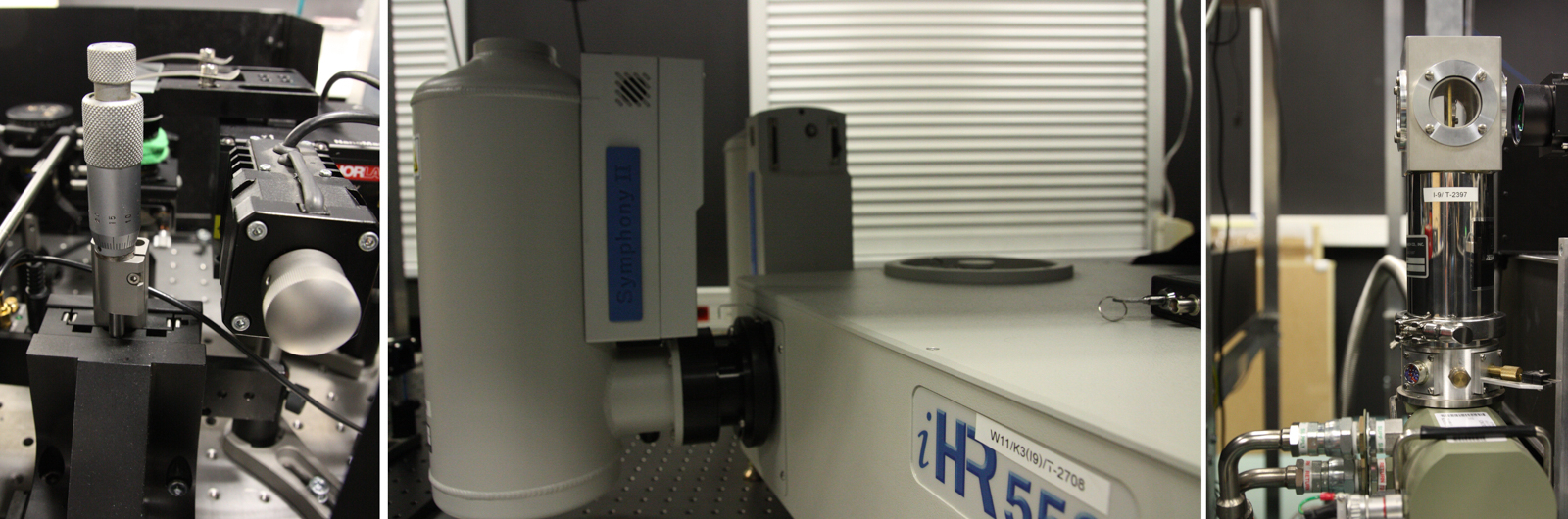
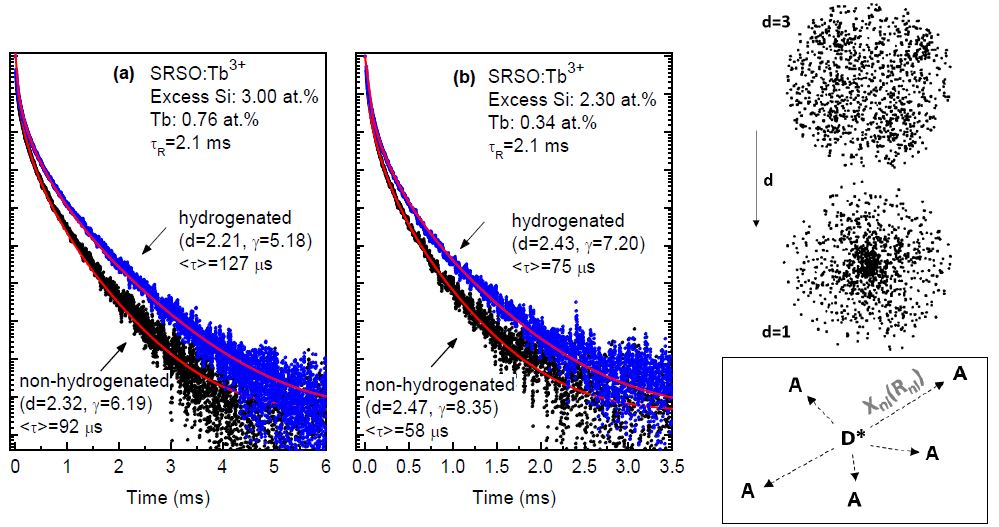
Our group specializes in many different optical spectroscopy techniques, such as time-resolved optical spectroscopy (in a very broad range, from nanoseconds up to miliseconds) or micro-Raman scattering spectroscopy (down to ultra-low acoustic frequencies). We use these methods to study various optical phenomena occurring in colloidal nanostructures synthetized in our lab. Broadly speaking, our interest lies in understanding and controlling light emission and absorption processes in such nanostructures as well as their vibrational dynamics. Besides fundamental science, this knowledge allows us to design better materials and to optimise production processes.
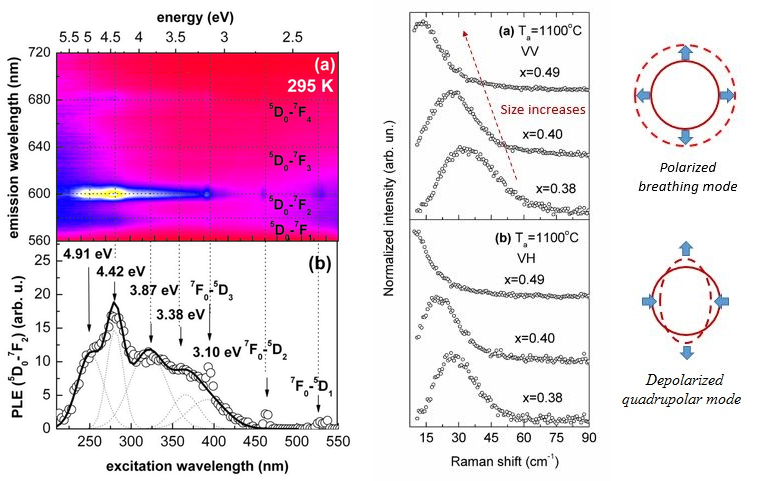
Right: Ultra-low frequency Raman spectra of silicon nanocrystals with different sizes, measured at different polarization geometries. These spectra show that acoustic phonons confined in silicon nanocrystals have size-dependent energies and different symmetries. [Phys. Rev. B. , 91, 235444 (2015)]